
Every accepted request — and every rejected one — is stored and visible. The event log is where you answer “did it arrive?”, “what was in it?” and “what did my app say?” without reading your own logs.
Live tail
Section titled “Live tail”The source’s Overview tab streams events as they arrive: a webhook that lands while the page is open appears without a refresh. Each row shows the method, the size, the verification result and the time.
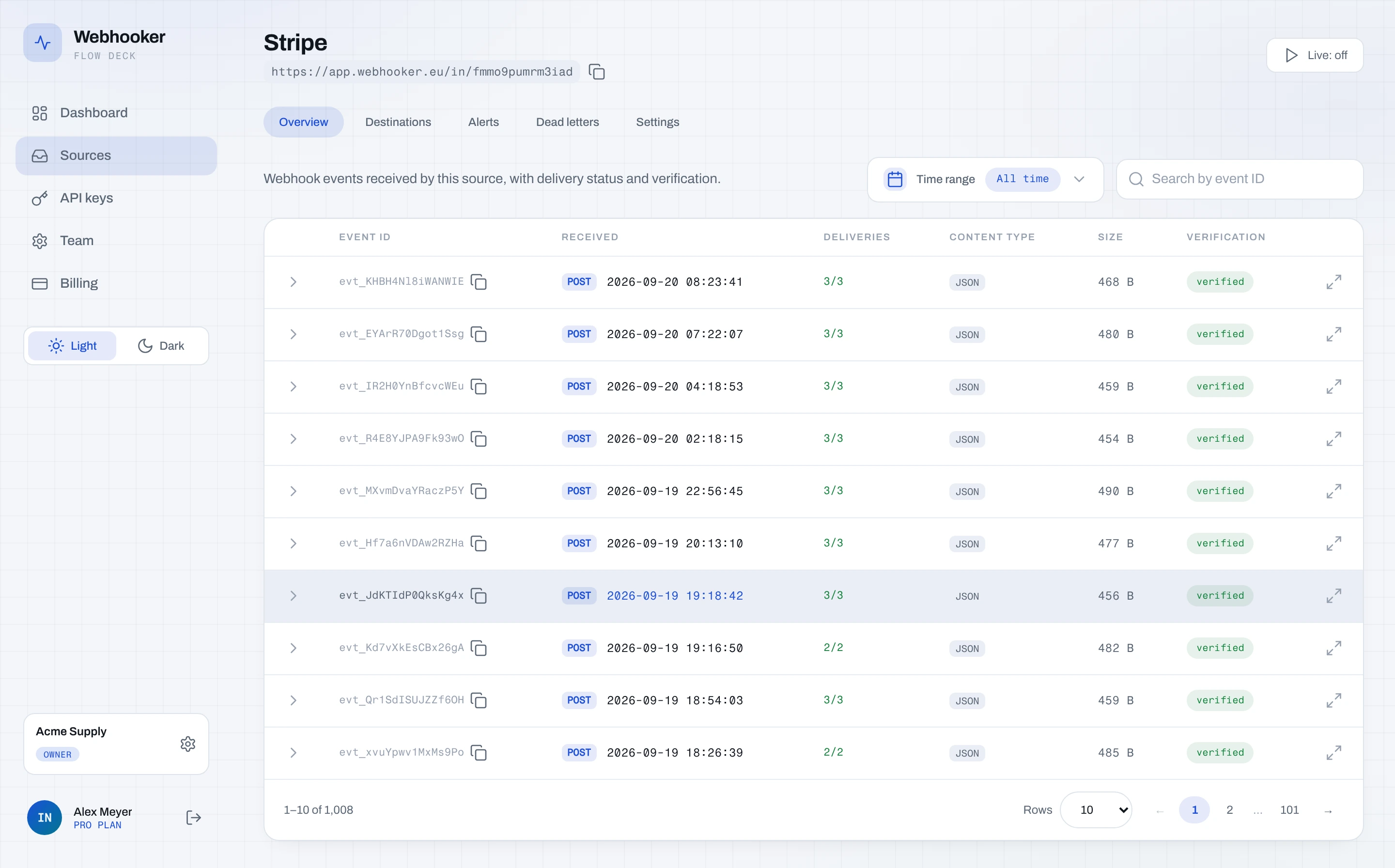
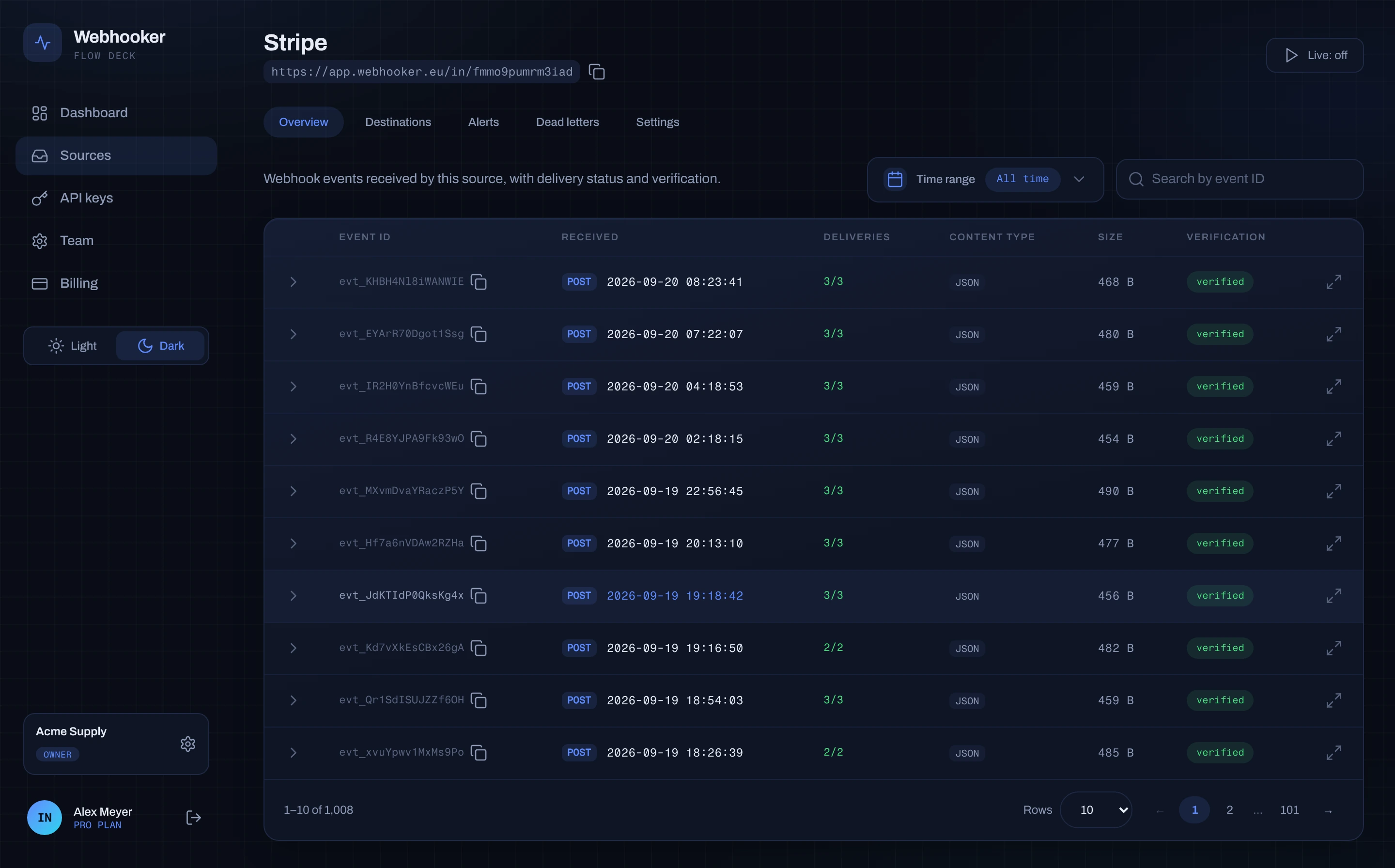
Live tail is a view, not a buffer. Closing the page loses nothing — the events are already stored.
The number of concurrent live streams per workspace is capped by your plan, so close tabs you are not watching. Programmatic access to the same stream is in the API reference.
Event detail
Section titled “Event detail”Click an event to see:
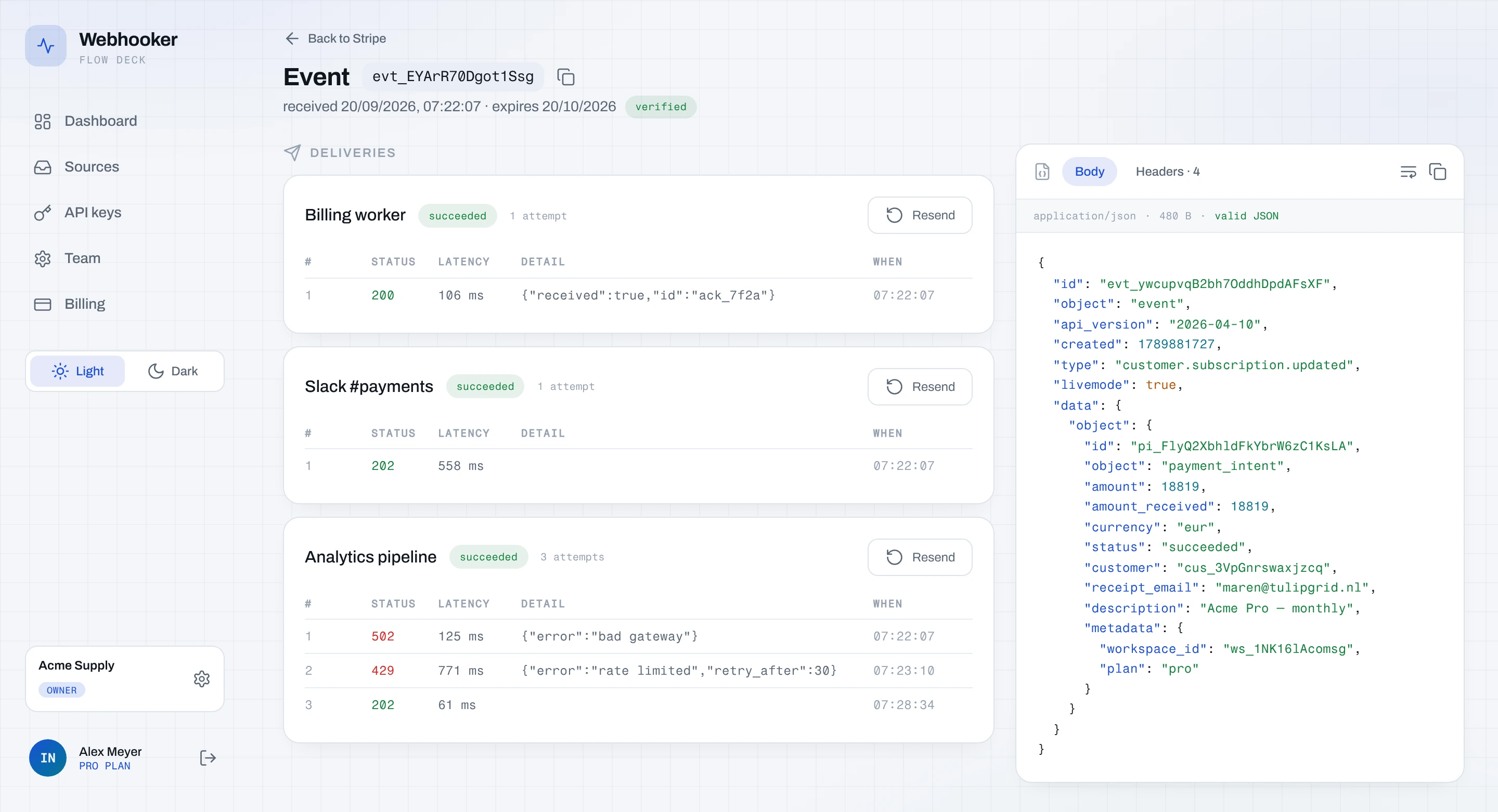
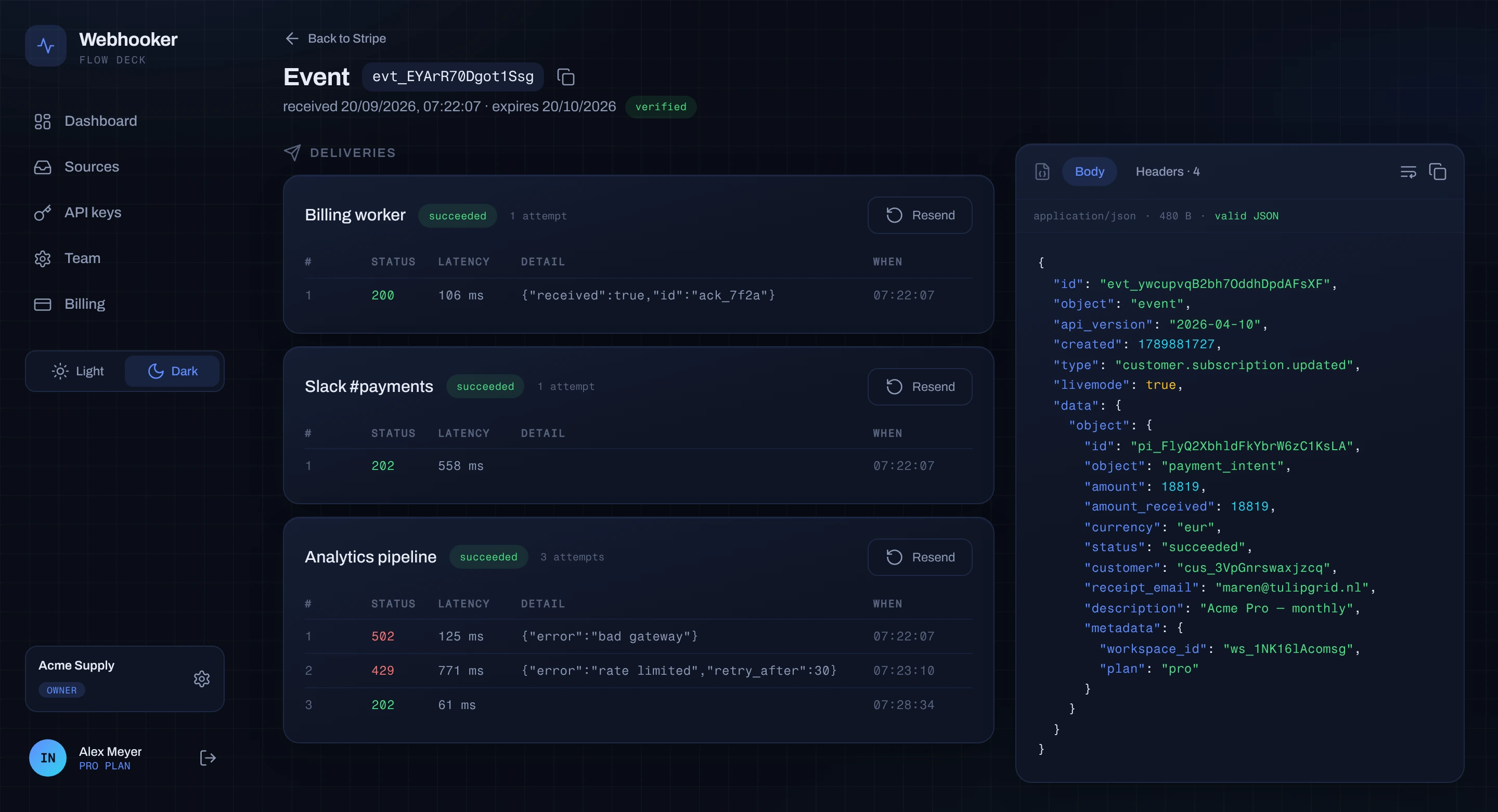
- Request — method, received time, content type and payload size.
- Headers — every inbound header, exactly as sent.
- Body — the raw payload, pretty-printed when it is JSON. Binary payloads are also available base64-encoded.
- Verification —
verified,failedorskipped. - Deliveries — one row per gateway, each expandable into its attempts: attempt number, target URL, response status, response body, error message and latency.
That last section is the one to screenshot when a provider or a teammate claims a webhook never arrived.
Searching
Section titled “Searching”The events list can be narrowed by source, by verification result, by time window, and by event id. The API exposes the same filters as query parameters, which is the easier route when you need to pull a day’s worth of failures into a script.
Resending
Section titled “Resending”Any stored event can be resent to its gateways from the event detail view. A resend creates fresh deliveries and runs the normal retry schedule; disabled gateways are included, because a resend is an explicit operator action. Bulk replay for a whole backlog lives in the source’s Dead letters tab — see retries and replay.
Retention
Section titled “Retention”Events are kept for the retention window of your plan — 14, 30 or 90 days — and then permanently removed together with their deliveries and attempts. The window is stamped on each event when it arrives, so upgrading a plan extends only the events received afterwards.
Deleting a source moves it to the trash; its events are removed with it after the 7-day grace period.
If you need webhook history beyond your retention window, forward the events to a gateway that archives them on your side.